
Ferrum College is exited to announce the launch of the Appalachian Music program and its new music ensemble, Orchestra Appalachia, during a Facebook Live event on Friday, August 7, 2020 at 2 p.m. Visit Music at Ferrum College’s Facebook page here to view the recital.
The virtual recital will feature Jake Blount, Uma and Giri Peters, and After Jack’s Emily and Rachel Blankenship-Tucker. Performances will showcase the living tradition of modern old-time music.
Ferrum College’s new Appalachian Music Program, under the direction of Emily Blankenship-Tucker, welcomes all musicians, vocalists, and dancers, of any skill level, to join and celebrate the region’s rich Appalachian heritage and music while also recognizing the present time and place. The program is open to students, faculty, staff, and community members. Email ebtucker@ferrum.edu to learn more.
 Ferrum College is excited to announce the creation of the Michael T. Christian ’63 Center for First-Year Experience, made possible by a generous contribution from alumnus Michael Christian.
“I made some friends at Ferrum who were serious students. As a result I became serious about succeeding in college and beyond,” said Christian, who graduated from Ferrum Junior College in 1963.
The Center will serve all incoming freshmen, including those who are the first in their families to attend college. Its goal is to integrate first-year students into college life by connecting them to an academic and social network of professors, mentors, and classmates to help them have a successful college experience. Students will also be connected to other resources at Ferrum College such as clubs, campus engagement, and career services.
“The transition from high school to college can be daunting, especially for the approximately 25 percent of our student body who are the first in their family to attend college,” said Vice President for Institutional Advancement and External Relations Wilson Paine. “The Michael T. Christian ’63 Center for First-Year Experience is designed to make sure our first-year students won’t feel lost as they begin their college journey.”
“The Michael T. Christian ’63 Center for First-Year Experience is the perfect location to study and gather with other students. FYE provides students with a variety of resources to help them perform to their highest potential. These include academic coaching, events, Gateway and Freshmen Orientation courses, and much more,” said First-Year Experience Coordinator Michelle Carter.
After graduating from Ferrum Junior College, Christian went on to earn his bachelors degree from the University of Tennessee-Knoxville. He then commissioned into the United States Army as a second lieutenant and later discharged as a captain. After his military service, he became executive vice president of Nations Bank, now Bank of America, and served as president and chief executive officer of three additional community banks. He also chaired two United Way campaigns and was chairman of the board for Tusculum College. Christian remains involved as a consultant to an east Tennessee regional financial services company and has participated in other civic activities, including previously serving on the board of directors for the Federal Reserve Bank (Nashville branch) and the Tennessee Bankers Association.
“I attribute much of my success to Ferrum,” said Christian. “What I gained there is worth much more to me than the monetary donation I made to the school.”
“We are immensely grateful to Mike for his contribution to the Center,” said Paine. “Every day, he lives by our motto, ‘Not Self, But Others’, and is a true champion for Ferrum College students.”
Read more about the Michael T. Christian ’63 Center for First-Year Experience here.
 (July 9, 2020) The Virginia Tobacco Region Revitalization Commission has awarded Ferrum College $40,000 over the course of one year to help fund a cybersecurity Internet of Things (IoT) lab project for the College’s Computer Information Systems program.
“Our computer technology and information systems program has always trained students in software interfacing, network security, and hardware troubleshooting, explained Dean of Arts and Sciences, and Professor of Chemistry and Physics, Jason Powell. “By upgrading our computer hardware laboratory to the IoT Laboratory with the help of a $40,000 grant from the TRRC, Ferrum College will be able to expand training opportunities to include certificate programs and courses in human interfaces with emerging technologies in systems of interconnected devices.”
“The IoT are devices – most likely sensors, like security or smart home systems, smart cars, thermostats, even vending machines – that collect and exchange data without human-to-computer or human-to-human interaction. That data is then fed to machine-learning algorithms which convert it into knowledge to support decision-maker systems,” explained Assistant Professor of Computer Information Systems Omar Darwish.
The IoT lab project will focus on designing, programming, and debugging sensors, robots, and embedded systems that can operate and interact with humans in unstructured environments.
How does this happen? “Students will learn how to attach different types of sensors to drones and rovers to explore unreachable areas,” said Darwish, who will facilitate the program’s lab work, under the direction of Dean of Arts and Sciences and Professor of Chemistry and Physics Jason Powell. “Sensors will gather data and send them to specialized processing units that have models which are built using machine learning algorithms. Finally, the model makes a decision to do specific action.”
The program is aimed toward computer science students, but students in fields such as physics or chemistry may also want to participate. If necessary, the theoretical portion of the course can be administered online; however, the practical portion must involve classroom or lab study.
“As our world becomes more and more connected the need for experts in computer technology and cybersecurity will only increase. It’s important that we take advantage of the opportunities this growing field can bring to Southern and Southwest Virginia and this program helps ensure that we are able to do so,” said Tobacco Commission Chairman Delegate Terry Kilgore.
“We are thrilled to receive such a generous grant from the Virginia Tobacco Region Revitalization Commission,” said Provost and Vice President for Academic Affairs Aimé Sposato. “With technology continuously progressing, this program is a must for Ferrum College’s Computer Technology and Information Systems students. We look forward to working with the Tobacco Commission to do our part in advancing cybersecurity.”
Learn more about Ferrum College’s Computer Technology and Information Systems program here.
Learn more about the Virginia Tobacco Region Revitalization Commission and its work here.

Ferrum College Fitness Center
Beginning next month, Ferrum College’s fitness center and the Franklin County Family YMCA will update their partnership, which has been ongoing since 2012, to allow the College to independently operate its workout facility on campus. The arrangement will allow the College to expand the experiential learning opportunities it offers its students.
“Moving our Health and Human Performance (HHP) classrooms into the fitness center will provide a framework for experiential learning,” said Karen Carpenter, assistant professor and program coordinator of the HHP program at Ferrum College. Carpenter will also serve as the general manager of the fitness center.
“Beginning this fall, we will add three national certification opportunities in strength and conditioning, personal training, and group fitness,” continued Carpenter. “Group fitness classes, student personal training, nutritional analysis, sport specific strength programs, movement training, and overall business operations are all academic and experiential opportunities for our HHP students.”
Carpenter noted that the community will also benefit by gaining access to short-term programs and long-term credentialed professionals.
Previously, Franklin County Family YMCA members used the College’s fitness center, which operated as the Ferrum YMCA. This perk will continue through the upcoming year for the approximately 100 members of the Ferrum YMCA branch.
Ferrum College employees will continue to be able to use the fitness center for free, and the Franklin County Family YMCA will also offer a discounted membership to the College’s employees, to be used at the facility in Rocky Mount.
“The Y is excited to continue our collaboration with Ferrum College to improve the lives of residents,” said Kevin McAlexander, chief executive officer for the Franklin County Family YMCA in Rocky Mount. “The Y is a leader in not only health and wellness but youth development and social responsibility which makes us a natural partner for the College.”
Ferrum College is using this summer to give the fitness center a facelift by refreshing the facility and updating the equipment. College officials anticipate opening the fitness center around mid-August when students begin returning to campus. Current members of the Ferrum College YMCA will receive further communication as more concrete plans are made.
“It is with excitement we take on the opportunity to create a living lab for the HHP program,” said Carpenter. “Our vision is bold and we are thankful for the trust of our administration as we transition the Ferrum fitness center and allow it to evolve into a vibrant hub of health and community.”
Learn more about Ferrum College’s Health and Human Performance program here.
Learn more about the Franklin County Family YMCA here.
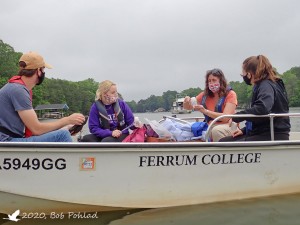
Ferrum College students work with Professor of Environmental Science Delia Heck during the 34th season of the Water Quality Monitoring Program. Left to right: Samuel Chappell; Michelle Musick; Delia Heck; and Chelsea Zizzi. Bob Pohlad photo.
Last week, the Smith Mountain Lake Association (SMLA) and Ferrum College Water Quality Monitoring Program began its 34th season. Since 1987, Ferrum College has worked with the SMLA to perform periodic testing of the lake water to help keep swimmers and boaters safer.
The Ferrum College portion of the team is made up of Program Director and Professor of Environmental Science and Natural Science Division Chair Delia Heck; Senior Scientist and Retired Professor Emeritus of Chemistry and Environmental Science David Johnson; Senior Scientist and Retired Professor Emeritus of Biology and Horticulture Bob Pohlad; Program Scientist and Assistant Professor of Biology and Horticulture Clay Britton; and Laboratory and Field Coordinator Carol Love.
Heck took over the director’s position after the January 2020 death of former Program Director and Retired Professor Emeritus of Environmental Science Carolyn Thomas. Thomas helped found the program.
This year, the team also consists fifty-four citizen scientists at Smith Mountain Lake who volunteer their time, and five paid Ferrum College student interns: senior Jacob Blaukovitch who is pursing a degree in chemistry, biology, and pre-professional health science (pre-med), with a one health minor; senior Lexi Davidson who is majoring in environmental science and minoring in biology; senior Michelle Musick who is earning an environmental science degree; senior Samuel Chappell who is majoring in environmental science and plans to graduate this December; and junior Chelsea Zizzi who is pursing a major in chemistry with a minor in English.
The Water Quality Monitoring Program is a labor of love for the Ferrum College team as it commands many hours during the summer months. “We test for bacteria every two weeks at fourteen sites with two stations at each site,” explained Heck. “We conduct depth profiles at five sites every two weeks. Our volunteers monitor and interns collect samples at fifty-six lake sites and twenty-two tributaries for trophic status monitoring.”
The team tests for e-Coli and other harmful bacteria. They also monitor algae biodiversity, watching for harmful algal blooms.
This year’s testing is even more complex than previous years due to COVID-19 restrictions. Heck said the team has developed safety protocols, including restricting interactions in the testing lab and with volunteers, implementing virtual training videos, rigid sanitizing, social distancing, wearing masks, and taking their temperatures daily. Each team member and volunteer also uses their own equipment including hand sanitizer, pens, personal flotation devices, and more.
Heck explained that water quality testing is not only important to keep swimmers and boaters safe, but is also an indicator of challenges in our environment. “Water is essential to our life on Earth. We face a changing climate and the interconnectedness between humans, health, and the environment are made clearer every day,” said Heck. “The project will continue to serve as an early warning sentinel as well as a model for how to to work collaboratively with our neighbors in living out our motto of Not Self, But Others. The partnership with the business sector, state government, and community exemplifies the very best Ferrum College has to offer our region.”
***
The 34th season of water quality monitoring has been dedicated to Carolyn Thomas, founding member of the program and beloved Ferrum College professor. The following statement was sent to this year’s citizen scientists in her honor:
“The Smith Mountain Lake Association and Ferrum College Water Quality Monitoring Program are dedicating the 2020 monitoring season to the memory of Dr. Carolyn Thomas, one of the founders of the program. Carolyn passed away in January after a courageous two-year battle with cancer. Carolyn’s passion for water quality was evident every time she ventured out on the lake. You can see that demonstrated in this interview with John Carlin from a few years ago.
“One of the traditions of the College’s sampling trips is to count great blue herons, Carolyn’s spirit animal. From now on when one is sighted we hope you will be reminded of Carolyn’s passion, her dedication to Smith Mountain Lake, and her love of citizen scientists like yourselves.”
Read more about the Smith Mountain Lake Association and Ferrum College Water Quality Monitoring Program here.
Ferrum College welcomes gifts made to the Carolyn Thomas Memorial Fund which supports students in the College’s Division of Natural Sciences. Please click here to make a gift in Thomas’s honor.
 Ferrum College will honor 199 graduates during an online commencement on May 9, 2020 at 10 a.m. The College was forced to postpone its 104th in-person commencement ceremony because of the coronavirus.
The virtual event will feature videos from Ferrum College President David L. Johns, Provost and Vice President for Academic Affairs Aimé Sposato, along with members of the senior class. Retired Professor Emeritus of Environmental Science and Biology Bob Pohlad will bring the keynote address. In addition, a number of celebrities will make guest appearances.
Although the ceremony will be delivered differently this year, the College will follow much of the traditional commencement format including the bestowing of faculty and student awards, presentation of graduates, and conferring of degrees. The Panther Marching Band will also perform the College’s “Alma Mater”.
“I wish we could gather on campus with family and friends to celebrate our new graduates. Nevertheless, we will not allow anything to stand in the way of honoring and recognizing the remarkable achievements of our students,” said Johns. “In the history of semesters, none has been more unusual than this one. The class of 2020 will be remembered for generations to come because they faced the most daunting of circumstances, and yet they exhibited imagination, grace, and grit. They are Ferrum Strong, and they are ready for anything life presents them!”
View program details here.
 Ferrum College is planning to hold a virtual commencement for graduating seniors on Saturday, May 9, 2020 at 10 a.m. The ceremony will include the presentation of graduates, special speakers, conferring of degrees, and a video of the Panther Band.
Plan to watch it here.

Dr. Bob Pohlad photo.
Ferrum College President David Johns announced today in an email communication to campus that courses will continue to be taught online for the remainder of the spring semester, and that spring commencement would be hosted virtually.
The College’s decision comes after yesterday’s Executive Order from Governor Ralph Northam, which closed all K-12 schools in Virginia for the remainder of the school year due to the coronavirus outbreak across the country.
“In light of these local and statewide announcements, it is prudent for us to take these steps so students and families can plan accordingly,” Johns wrote in the email.
The College initially moved to an online distance learning plan effective last Wednesday, March 18, with the intention to reassess the option to have students return to campus to finish coursework after April 6.
Students who are currently living on campus will be allowed to stay. They will continue to receive grab-and-go meals from the cafeteria and will participate in the same online instruction as those who chose to leave campus.
Ferrum College will host a virtual commencement ceremony on May 9. Johns indicated that an in-person ceremony may take place during the fall, depending on the circumstances. “Rest assured, we fully intend to recognize and celebrate the remarkable achievements of this class,” he wrote.
“These are unprecedented times and we are all making adjustments and sacrifices for our own health and safety as well as that of others,” Johns wrote, closing his email. “We are all in this together, and we are all here for each other.”
To view Ferrum College’s official updates and announcements, please visit www.ferrum.edu/coronavirus.

Ferrum College and NRCC signed an articulation agreement today to offer a pathway to four-year degrees for NRCC transfer students. Pictured from left to right: Ferrum College Provost & Vice President for Academic Affairs Aimé Sposato; Ferrum College President David Johns; NRCC President Patricia Huber; & NRCC Vice President for Instruction & Student Services Peter Anderson. NRCC photo.
Ferrum College and New River Community College (NRCC) signed an agreement on Wednesday, February 26, 2020, guaranteeing admission into Ferrum College for NRCC students who have received an associate degree. In addition, as part of the Ferrum Promise initiative which was rolled out in November 2019, Ferrum College also pledges that these NRCC students will be able to graduate with a four-year degree in their field of study within two years of transfer to Ferrum, or tuition for their remaining coursework will be free.
“Ferrum College is delighted to begin working with New River Community College to provide a pathway for NRCC students to obtain a bachelor’s degree in two years as our Ferrum Promise guarantees,” said Ferrum College President David Johns. “Both our institutions are committed to our students’ futures and to providing the resources they need for innovative and meaningful work.”
“NRCC is pleased to partner with Ferrum College to provide this new opportunity to our local students. In addition to our existing articulation agreement with Ferrum that allows NRCC students to transfer easily, the Ferrum Promise goes one step further to help students stay on track and be successful on their journey to earn a four-year degree,” said NRCC President Pat Huber. “Today is an exciting day for NRCC students, and this is a great way for them to complete their pathway to success.”
The memorandum of agreement states that acceptance at Ferrum College will require NRCC students to have maintained a cumulative overall GPA of 2.3 or higher, and earned a grade of “C” or higher in required courses applicable to the program they choose to enter. Additionally, NRCC students must have earned either an Associate of Arts and Sciences or an Associate of Applied Science degree prior to acceptance at Ferrum.
The agreement was signed on the NRCC campus by Huber and Johns, along with Vice President for Instruction and Student Services Peter Anderson, and Ferrum College Provost and Vice President for Academic Affairs Aimé Sposato.
“Our partnership with New River Community College illustrates both of our institutions’ commitment to our students,” said Sposato. “Higher education is changing and our methods of providing a top-notch education must also change to help our students start making a difference in the world sooner than later. We are honored to partner with NRCC for this opportunity.”
Learn more about Ferrum College’s Ferrum Promise here.
Learn more about New River Community College here.
Ferrum College’s annual President’s and Dean’s List Dinner was held in the Blue Ridge Mountain Room on January 31, 2020. During the dinner, College officials recognized 258 Dean’s List recipients and 97 President’s List recipients for spring 2019. For fall 2019, 290 students were named to Dean’s List and 103 to President’s List.
To qualify for Dean’s List, a student must be full-time with a grade point average of at least 3.4 out of a possible 4.0. Students named to President’s List are full-time with a grade point average of 4.0 at the end of the spring and fall semesters.
See photos from the evening here.
Find students named to the President’s List here.
Dean’s List students are named here.

The cover design of fall 2019’s “Chrysalis” is by Ferrum College senior Anthony Wilson, Jr. ’20.
On Tuesday, December 10, 2019, Ferrum College Chrysalis Literary and Arts Magazine staff revealed the fall 2019 edition of the magazine in the Blue Ridge Mountain Room on campus. Submissions to the magazine were canvassed from across campus with winners in four categories: visual art, prose, photography, and poetry.
Senior Heather Ellis from Hardy, VA, received first place in poetry for “Signed, A Silent Onlooker” and in prose for “A Never-Ending Cycle.” First place for photography was awarded to senior Amber Scott of Stuart, VA for “Blue Skies.” First place award for visual arts went to junior Ashlynn Willoughby of Wilmington, NC for “Growth.” The Chrysalis cover photo is by senior Anthony Wilson, Jr., from Woodbridge, VA.
Judges included Ferrum College alumnus Mike Dunavant ’93, who evaluated the photography category; Ferrum College alumna Amanda Cholko ’14, who reviewed the poetry category; local artist Jane Lillian Vance, who evaluated the visual art category; and journalist and author Janine Latus, who evaluated the prose category.
The Chrysalis staff is comprised of Ferrum College students: editor-in-chief Heather Ellis; photography and visual art committee members sophomore Chloe Fisher (chair) and freshman Kristina Cossa; poetry committee members senior Kathryn Bonner, junior Abigail McGovern, and junior Jacques Moore-Roberts; and prose committee members senior AnnGardner Eubank (chair) and sophomore Shela Muriel. Chrysalis advisor is Ferrum College Professor of English Katherine Grimes.
Read this semester’s edition of Chrysalis Literary and Arts Magazine here.
 Ferrum College junior Suzanne “Suzie” Maines spent the fall semester a long way from her hometown of Winchester, VA. In August, Maines traveled to Denmark and then to Sevilla, Spain to begin a semester-long study abroad program. She left Spain on December 11 to spend more time in Denmark until she arrives back in the United States on January 6, 2020. Maines is majoring in Spanish and international studies and plans to graduate in May 2021.
Studying abroad was attractive to Maines for two reasons: she wanted to explore a new place, and she really wanted to improve her Spanish. “The best way to do that is through immersion,” she said.
Maines spent the fall semester studying at the Spanish Studies Center in Sevilla. She found some similarities to Ferrum College: the classes at the center, although taught only in Spanish, were all small in size and the professors were understanding and patient. However, there were lots of differences.
“The typical day in Sevilla is quite different than a day in the United States especially when it comes to meal times and scheduling in general,” Maines said. “Breakfast is very small, usually just toast with butter, lunch is a very long sit-down meal around 2:30 p.m. that takes about an hour to an hour and a half, and then dinner is usually at 9:30 p.m. or even later if you decide to eat out.
“Nightlife here starts very late, usually around 1:30 to 2:00 a.m.,” she added. “This is possible because of siesta. Everything kind of slows down and closes and people rest in their houses and sleep because it’s insufferably hot in southern Spain.”
Maines enjoyed being away from her normal routine while in Sevilla. “Studying abroad feels as if you’re in this little bubble and it’s very relaxing and euphoric,” she explained. “You’re away from all your problems and the same settings you’ve been seeing all your life so it feels like you have a fresh start. Even if it’s only temporary you’re definitely living in your own little world while you’re there.”
Visit here to learn more about study abroad opportunities at Ferrum College.