
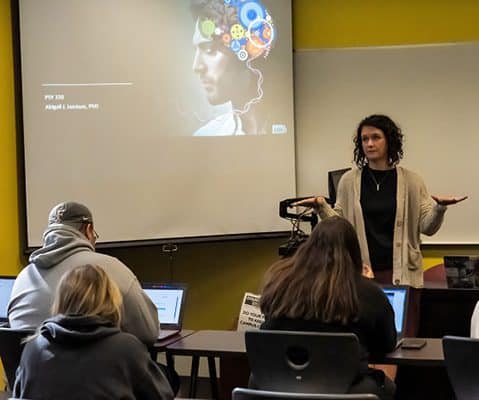
The psychology major educates students about diverse topics within psychology, teaches critical thinking and scientific reasoning skills, develops professional writing and communication skills, and provides students with opportunities to perform research and gain firsthand experience in the field. The major encourages students to explore various subfields within our profession so that students can find their passion and tailor their degree to their long-term goals.
An introduction to the basic concepts, methods, theories, and applications of psychology.
This course is a study of the biological basis of normal and abnormal behavior, including sensory systems, brain and behavior relationships, and underlying neurochemical processes.
A scientific investigation of the interaction between social stimuli and cognition and behavior of the individual. Topics will include attitude formation and change, conformity, leadership, interpersonal perceptions, persuasive communications, attribution processes, and group dynamics.
Mental health professional in charge of performing psychoanalysis to diagnose mental illness and provide treatment for mental and behavioral issues.
Offer guidance to individuals, couples, families, and groups who are dealing with issues that affect their mental health and well-being. Many counselors approach their work holistically, using a “wellness” model (as opposed to an “illness” model), which highlights and encourages clients’ strengths.
Mainly responsible for enforcing the law and protecting the public. Police officers detect and prevent crime in particular areas and complete assignments from their supervisors.
View the catalog for all program courses and degree requirements.