 He came and went like the wind. Determined. Driven. Focused. Quiet. Unassuming. “When he was here, he was in the zone,” said Rachel Walton, Interlibrary Loan Coordinator/Technical Services Assistant at Stanley Library. “He was dedicated to his project.”
The person is Micah Allen, a 2022 Ferrum College graduate who majored in history and political science, from Goochland County—just outside Richmond. The project was tracing the history of the Black Student Union (BSU) at Ferrum College and the inclusion of Black students in general. He mined old, bound volumes of the campus newspaper the Iron Blade from the late 60s to early 80s, identifying anything related to the BSU, scanning and transcribing the articles as he moved through them.
The work was similar to a project he undertook with the Blue Ridge Institute and Museum. The BRIM project focused on digitizing all of the Appalachian folktales and stories collected by the folklorist James Taylor Adams in the 1940s, saving them all in the digital archives, and posting them all on Professor of English Tina Hanlon’s AppLit website. Hanlon’s website site, AppLit: Resources for Readers and Teachers of Literature for Children and Young Adults, has been up and running for 20 years and has won the Appalachian Studies Association’s e-Appalachia award in the past.
“I scanned and transcribed the folk stories,” Allen said. “I first got one of the stories and then scanned it using a printer to get it onto the computer. After the scanning process, I then transcribed what I just scanned onto a word document, word-for-word, to the best of my abilities.”
Bethany Worley, BRIM Director, sang Allen’s praises on the project. “Micah was such a pleasure to work with,” she said. “He was detail oriented, which is a must when working with archival materials. I appreciated his enthusiasm for the special collection of folktales, history, and folksongs of the James Taylor Adams collection.”
For his part, Allen relished the undertaking. “I enjoyed my time working at the BRIM and doing this project because I saw it as preserving the history of the region,” Allen said. “Doing this allows future generations to be able to learn about their home and culture.”
Allen’s main interest, however, seemed to be his Stanley Library internship and the BSU/Iron Blade research he conducted. “I found some interesting editorials written in the Iron Blades in the early 80s dealing with the Black Student Union getting more funding than other groups on campus,” he said. “I found them interesting just to see the individual arguments being made for why they are getting more money than other school organizations.”
At some point, he said, the BSU apparently disbanded on campus. “I have not found if or when the BSU dissolved,” Allen said. “I was told that there was a point where they kind of just disappeared, but now I have seen that they are back. I hoped the further I went into my research, I would be able to find the answer.”
As is the case with many students, Allen underwent a time of growth here at Ferrum. “He was definitely one of our Class of 2022 star graduating seniors in the history major, and I have had the luck to watch him grow,” said Assistant Professor of History Michael Hancock-Parmer. “Micah arrived as a shy, typically insecure freshman student—maybe convinced that he was just going to see things through, not sure of what he was going to be capable of. Somewhere along the road, he came into his own.”
Fellow Assistant Professor of History Nicole Greer Golda echoed the sentiments. “Micah really blossomed in his years at Ferrum and developed a deep knowledge of our recent past, especially African American history,” Greer Golda said. “His senior seminar research into the meanings of democracy in the United States for African Americans during World War I demonstrated his commitment to preserving a wide array of sources.”
Allen plans to continue his education at J. Sargeant Reynolds in Richmond and study as a paralegal.
Article written and contributed by Assistant Professor of English & Journalism David B. Campbell.
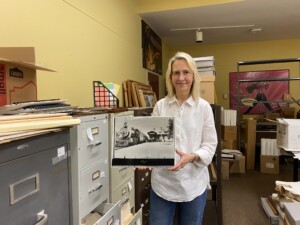 The Blue Ridge Institute and Museum (BRIM), located at Ferrum College, recently received a donation of local Franklin County historian Dorothy Cundiff’s collection, which consists of eight file cabinets containing years of Cundiff’s research on Franklin County history plus other memorabilia. Cundiff, a Franklin County lifelong resident, dedicated years of her life to researching the county’s local history and produced forty-two pictorial history books.
BRIM Director Bethany Worley was excited to receive the gift of Cundiff’s collection, as well as an endowment to support the preservation of the collection. Worley noted BRIM is honored to be entrusted with Cundiff’s lifelong work. “We will honor her wishes and make sure her legacy lives on so that others can use and benefit from all her labor. Clearly, she loved history. She found history in everything and everyone.”
According to Worley, it will take many hours to research, catalog, identify, and digitize the collection for widespread public use. In addition, the BRIM will share a sample of the collection at The Depot in Rocky Mount.
To view additional photos of the collection, click here.
Read Leigh Prom’s article about Dorothy Cundiff’s collection that appeared in The Franklin News-Post here.

FERRUM, VA, April 28, 2022 — Ferrum College hosted a ribbon cutting and reception celebrating the new Richard L. Smith Center for International Programs on Friday, April 22, 2022. The ribbon cutting took place in Hart International Plaza beside Stanley Library, which is home to the new international center. A reception in the lobby of Grousbeck Hall followed.
Named in honor of the late Professor of History and Williams Distinguished Teaching Professor in the Humanities Richard Lee Smith, who was an avid world traveler, the newly named international center welcomes students from around the world to campus, opens the world to Ferrum students through study abroad, and offers programs designed to broaden perspectives and help students connect to the rest of the world.
Ferrum College President David Johns believes the Richard L. Smith Center for International Programs will be one of those places where the world comes together. “In a world that is too often polarized and where difference gives rise to division, the Richard L. Smith Center for International Programs will be a place of understanding and hope, a place of curiosity and inspiration,” he said.
The Richard L. Smith Academic Enrichment Award is a scholarship that supports a student’s international travel each year. Because of strong support for the scholarship so soon after it was created, the first recipient, Jessica Bollinger, was present at the center’s dedication after accepting the award at the annual Academic Awards Ceremony, and she will travel abroad this summer.
Wilson Paine, vice president of Institutional Advancement & External Relations and a former student of Professor Smith’s, noted that Smith pushed him to think of travel and personal experiences as an extension of the learning that occurred in the classroom. “He encouraged me to embrace opportunities that broadened my worldview and my own role in society. That is the essence of the Richard L. Smith Center for International Programs, and how fitting it is that it will now be named after Dr. Richard L. Smith.”
Smith, who died on February 24, 2021 at the age of 75, taught history at Ferrum College for 42 years. As a college professor, Smith taught more than 8,000 students, over 7,000 of them at the College. He was also a beloved husband, father, grandfather, and brother; a teacher and storyteller; an internationally recognized scholar; an author; an occasional performer and historical consultant at the Blue Ridge Dinner Theatre on campus; and a warm-hearted and generous member of the Ferrum community.
Smith was remembered fondly by his colleagues. Dr. Tim Daniels, associate professor of History and Chair of Humanities and Performing Arts, reflected that he came to teach at Ferrum College because of Smith. “That he trusted me with the reins of the history department is probably the most profound honor I’ve received over the past six years,” he said.
Daniels went on to note that Smith believed it was great if everything went according to plan while traveling, but that he also believed amazing stories were often created when it didn’t. “At some point, a Ferrum student who has benefitted from the center named in his memory is going to run into an obstacle that redirects their path and teaches them something about themselves they didn’t know they needed to learn. I like to think that it’s going to be Richard intentionally placing those bumps in their paths,” said Daniels.
Born on August 26, 1945 in Montgomery, West Virginia, Smith spent his childhood in Cranford, New Jersey, playing football and getting into things with his friends. He later moved to Moravia, New York, where he worked on his family’s dairy farm during summers and attended college courses at SUNY-Cortland. He earned his bachelor’s degree in history in 1967 and then enrolled at Rutgers University, where he received his master’s degree in 1969 and his Ph.D. in 1972, both in history. Prior to arriving at Ferrum College, Smith taught for four years at LaGrange College in LaGrange, Georgia.
Smith enjoyed teaching ancient Asian and African courses, including Chinese, Indian, Southeast Asian, North African, and sub-Saharan history, along with traditional Western European and American subjects. He was known to be a great storyteller who enthralled listeners with tales of his travels to the Sahara Desert, Timbuktu, Kenya, Egypt, Peru, and more. Some of these trips included his students who arrived home with hilarious stories and fond memories, including a rafting trip down the Tambopata River that ended in a crash and fire ant attack at their rainforest camp.
Once asked what he loved about Ferrum College, Smith responded, “Ferrum is special because it is a place where, as a teacher, I could help students maximize their potential if they were willing to work hard and dedicate themselves to achieving academic success. I am especially proud to see that so many of my former students have gone on to enjoy success in their chosen careers in business, public service, education, and a variety of other fields.”
To see additional photos of the ribbon cutting ceremony and reception, please click here.

Dr. Richard Smith
On February 24, 2021, the Ferrum College community bid a last farewell to Professor of History and Williams Distinguished Teaching Professor in the Humanities Richard Lee Smith. He was a beloved husband, father, grandfather, and brother; a teacher and storyteller; an internationally recognized top scholar; an author; and a warm-hearted and generous member of the community. Smith was 75 years old.

Smith rides atop a camel in the Taklamakan Desert.
Born on August 26, 1945 in Montgomery, WV, Smith spent his childhood in Cranford, NJ playing football and getting into things with his friends. He later moved to Moravia, NY where he worked on his family’s dairy farm during summers and attended college courses at SUNY-Cortland. He earned his bachelor’s degree in history in 1967 and then enrolled at Rutgers University where he received his master’s degree in 1969 and his Ph.D. in 1972, both in history.
After teaching for four years at LaGrange College in LaGrange, GA, Smith arrived at Ferrum College in 1976, where he would spend the next 42 years teaching history. As a college professor, Smith taught more than 8,000 students, over 7,000 of them at Ferrum College.
“Richard never waited until some other time to live life to its fullness. As was evident in the display of photographs at his retirement celebration in 2018, Richard leaned into life always,” wrote Ferrum College President David Johns in a recent email announcing Smith’s passing to the campus community.
“That his first students at Ferrum grew to be among his best friends is a testament to the impact he had on generations of Ferrum students,” said Professor of History Timothy Daniels, who was a colleague and personal friend of Smith’s.
He enjoyed teaching ancient Asian and African courses, including Chinese, Indian, Southeast Asian, North African, and sub-Saharan history, along with traditional Western European and American subjects. He was known to be a great storyteller who enthralled listeners with tales of his travels to the Sahara Desert, Timbuktu, Kenya, Egypt, Peru, and more. Some of these trips included his students who arrived home with hilarious stories and fond memories, including a rafting trip down the Tambopata River that ended in a crash and fire ant attack at their rainforest camp.

Smith performs in the Ferrum College drama production, “Too Free for Me” in 1998.
Smith authored three books, which earned him international recognition as a top scholar in ancient and medieval trade and commerce. At the time of his death, he was tirelessly working on a fourth book, a thematic study of trade and commerce in the ancient and medieval worlds.
“When Richard went into the hospital for some issues not directly related to his final medical problems, I told [his wife] Kathleen to relay to him that he’d better hurry up and get out of the hospital if he wanted to make progress on his book (which was four out of seven massive chapters done by the time of his death),” remembered Daniels. “She sent me a picture of him grinning in his hospital gown, in his hospital bed, with books and yellow legal pads splayed across his lap. Only death – not any illness – was going to get in the way of his scholarship.”
He appeared on Blue Ridge Public Television’s “Public Eye” program in the 1970s and 1980s, two PBS documentaries, and the television show “Digging for the Truth” with Josh Bernstein on the Discovery Channel. He also served as consultant for several History Channel shows.
Smith enjoyed performing for Ferrum College’s drama department and appeared in numerous plays including “Too Free For Me,” “Lil Abner,” “Fiddler on the Roof,” and more.

During a 2015 trip to Egypt.
He and his wife made their retirement home at Smith Mountain Lake in Wirtz, VA. There, he thoroughly enjoyed the water, captaining the boat that pulled his grandchildren across the lake during countless hours of tubing. He was a beer connoisseur and loved to grill, sharing his famous ribs and pulled pork platters with family and friends. Along with his limitless quest for knowledge, he loved music, organic gardening, and storytelling.
Once asked what he loved about Ferrum College, Smith responded, “Ferrum is special because it is a place where, as a teacher, I could help students maximize their potential if they were willing to work hard and dedicate themselves to achieving academic success. I am especially proud to see that so many of my former students have gone on to enjoy success in their chosen careers in business, public service, education, and a variety of other fields.”
“Some lives are so large, rich, and full, they spill over into the lives of others,” wrote Johns. “And not just an experience or a memory, but part of the energy and essence of that person becomes lodged inside those in his or her orbit. This was Richard, and there are many who carry within them part of the overflow of his extraordinary life.”
Smith is survived by his wife and soulmate Kathleen; sons Erik and Howard; step-children Kevin and Beth; and their families. Please share online condolences with the family here.
The family requests that memorial contributions be made to the Richard L. Smith Academic Enrichment Scholarship in History at Ferrum College.
 Students participated in a Model United Nations Security Council at Ferrum College on Saturday, March 18. A role-playing experience designed to convey the full richness, complexity, drama, and importance of international affairs, the Model United Nations Security Council is an annual event at Ferrum College that has been ongoing for more than 25 years. The Political Science, International Studies, and History Departments host the event.
“The event allows students from any major the opportunity to engage in real world events through a simulated Model United Nations Security Council meeting. The students have the opportunity to role play as one of the current country delegations sitting on the Security Council. The event is designed to broaden students’ understanding of world events, enhance their critical thinking and research skills, and develop their oral and written communication skills through the drafting and presentation of resolutions presented to the entire body. Students also engage in negotiation, debate, and diplomatic dialogue,” explained Assistant Professor of Political Science and International Studies Program Coordinator Dr. Sandra Via.
 “Students are given the opportunity to request a country that is currently represented on the UN Security Council from a list provided. However, the assignment of a delegation is on a first come, first serve basis. There are always 15 countries represented on the Security Council. Ten of those delegations rotate, and five are considered permanent members (also known as the P5) of the Security Council. The P5 countries are the US, UK, France, China, and Russia. These are typically the most coveted delegations,” continued Via.
“The topics of the Model UN change each year. We (the advisors) typically try to highlight three significant security problems occurring in the world. We also see what issues the UN Security Council is monitoring at the time the tentative agenda is created for the students. However, items can be added to the agenda. For instance, North Korea’s recent missile launches occurred after the tentative agenda was sent out to students, but several students wrote resolutions pertaining to the topic and added it to the agenda for discussion. Ultimately, participation in the event requires that students keep up with current events and be prepared for any possible situation,” Via concluded.